
All-Optical Mesoscopic Platform for Distributed Neural Circuit Interrogation
 Laboratory of Imaging and Intelligent Technology (LImIT), Tsinghua University
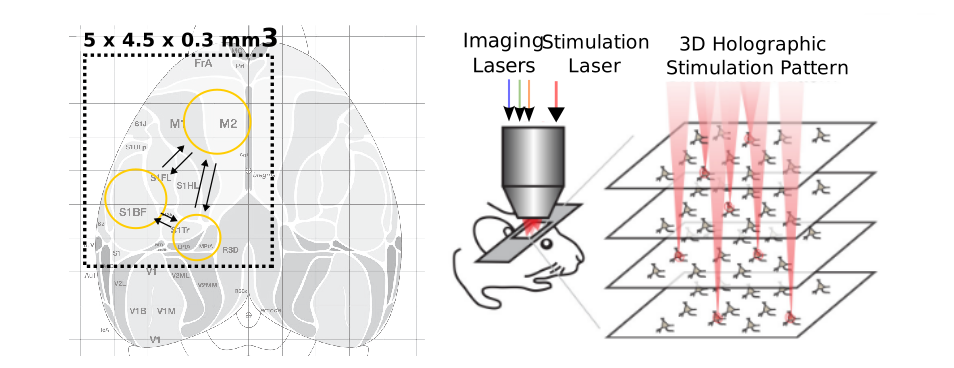
Motivation
Understanding how neural circuits coordinate across cortical regions during behavior remains a central challenge in systems neuroscience. How does information flow between areas during decision-making? How does consciousness manifest in distributed neural activity? Answering these questions requires tools that can both observe and perturb neural populations across multiple brain regions simultaneously, at single-cell precision, over extended time periods.
Platform overview
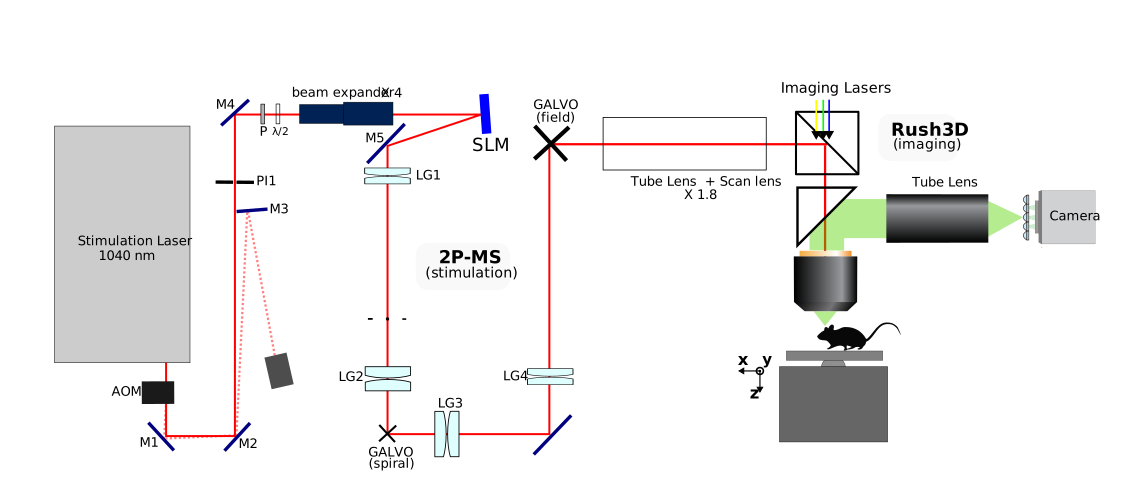
OMNIS (Optical Mesoscale Neural Interrogation System) combines scanning light-field microscopy for volumetric calcium imaging with two-photon holographic stimulation for targeted optogenetic activation. Together, these modalities enable chronic all-optical interrogation of neural circuits at mesoscopic scales with single-cell resolution.
Key capabilities
| Large addressable volume | 5 × 4.5 × 0.3 mm³ for both imaging and stimulation, spanning multiple cortical regions in a single preparation |
| Single-cell targeting | Holographic patterning via a spatial light modulator (SLM) with GPU-accelerated iterative phase retrieval |
| Simultaneous multi-point stimulation | Arbitrary 3D spot patterns steered across the field of view by a pair of galvanometric mirrors |
| Low phototoxicity | One-photon imaging is a key enabler of long-term observation |
Imaging path
The imaging arm is built on scanning light-field microscopy (sLFM)12, a one-photon volumetric technique that captures 3D information by encoding angular light-field data through a microlens array placed at the image plane. A piezo-electric mirror in the detection path performs 3x3 scanning with sub-pixel steps to enable recovery of high-fidelity volumes at single-cell resolution and high frame-rate. Because the entire depth of field is excited and detected simultaneously, excitation power stays low enough for chronic imaging over hours to days with minimal phototoxicity and photobleaching.
Stimulation path
A 1040 nm femtosecond laser is modulated by a liquid-crystal SLM encoding computer-generated holograms34, producing arbitrary 3D patterns of focused spots at the sample plane. Two galvanometric mirrors — a spiral galvo for fast local scanning and a large-aperture field galvo for wide-field positioning — steer patterns across the full addressable volume. Custom large-aperture tube and scan lenses preserve beam quality over the entire field of view.
Control system
A Python control system coordinates all hardware components and provides:
- GPU-accelerated holography — iterative Fourier transform algorithms (Gerchberg-Saxton, weighted GS) for real-time phase mask computation
- Calibration pipeline — six sequential scripts and Jupyter notebooks that characterize the optical system from coordinate frame registration through 3D aberration correction
- Experiment application — a desktop interface for loading target images, selecting stimulation sites, generating holographic patterns, and executing them on hardware
References
-
Lu, Z. et al. Long-term intravital subcellular imaging with confocal scanning light-field microscopy. Nat Biotechnol (2024). https://doi.org/10.1038/s41587-024-02249-5 ↩
-
Zhang, Y. et al. Long-term mesoscale imaging of 3D intercellular dynamics across a mammalian organ. Cell 187, 6104–6122 (2024). https://doi.org/10.1016/j.cell.2024.08.026 ↩
-
Russell, L. E. et al. All-optical interrogation of neural circuits in behaving mice. Nat Protoc 17, 1579–1620 (2022). https://doi.org/10.1038/s41596-022-00691-w ↩
-
Drinnenberg, A. et al. Large-scale cellular-resolution read/write of activity enables discovery of cell types defined by complex circuit properties. bioRxiv (2025). https://doi.org/10.1101/2025.10.21.683734 ↩