
Alignment
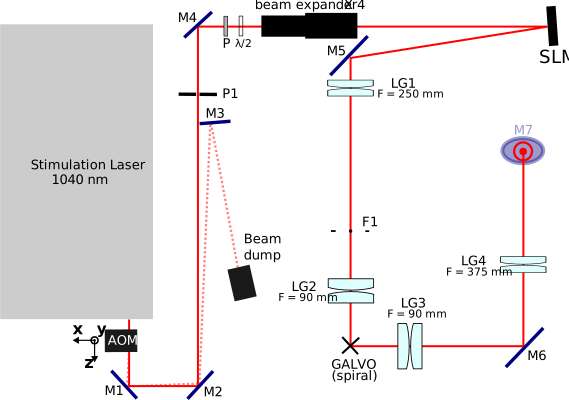
We can perform all the alignment using the low power mode of the femtosecond laser (max 100mW) to reduce safety risks. The following steps should be performed in order, from top to bottom, as each component’s alignment may depend on the previous ones.
AOM
Objective: Enabling power modulation of the laser beam while minimizing losses.
Metrics: Power of the 1st diffraction order at max applied voltage (5V on the RF driver, see Subsystems).
Method: The position and, most importantly, the angles between the incident beam and the AOM are critical as they strongly influence the energy efficiency of the 1st diffraction order. The most sensitive axis is the one that controls the Bragg angle (rotation around the Y axis).
To align, we use the manual 3D translation stage to adjust XYZ position so the laser beam passes through approximately at the center of the AOM. Then, we adjust the angle between AOM and laser beam using both the screws that fix the translation stage to the optical table (for coarse adjustment, mainly the Bragg angle axis) and the screws that fix the AOM to the translation stage (for fine angular tuning on both axes).
Once the alignment is OK, we should obtain around 85% transmission for the 1st order and 5V input voltage into the AOM (see Subsystems). If poorly aligned, the 1st order efficiency can drop below 20%.
Pinhole and beam dump
Objective: Selecting the 1st order diffraction order of the AOM with minimum losses.
Metrics: Not quantified, shape of the 1st order beam after the pinhole.
Method: We use Pinhole P1 to keep only the 1st diffraction order of the AOM, the other orders are cleared out. To align the pinhole, we set the AOM control voltage to 2.5V in order to see the multiple diffraction orders. We then position the pinhole so that only 1st order goes through. Mirror M3 is then positioned in order to reflect the 0th order into a beam dump. During experiments, due to the high power of the femtosecond laser, blocking 0th order with only a pinhole doesn’t guarantee a sufficient level of safety. It is not a major issue that other orders are not sent to a beam dump as they contain much less energy than 0th order during experiment.
Polarizer and half-wavelength plate
Objective: Align the laser beam polarization with the SLM proper axis
Metrics: For polarizer, the transmitted power is maximized. For the half-wave plate, we minimize the amount of light unmodulated by the SLM (by eye with a camera, see following method for details).
Method: A polarizer is used to assure linear polarization of the incident beam and the half-waveplate allows for rotation of the polarization axis. While polarization of the light has no impact on the experiment itself, proper modulation by the Spatial Light Modulator (SLM) requires the incoming laser beam polarization to be aligned with the proper axis of the nematics crystal inside the SLM.
Step 1, we find the rotation angle that maximizes the transmitted power through the polarizer using a powermeter.
Step 2, the half-wave plate rotation, however, can only be tuned after the SLM, Mirror M5, beam expander and Lens-Group (LG) 1 have been placed. In practice, at this stage, the half-wave plate is left at an approximate angle, and the fine adjustment is completed after the SLM section below. To correctly tune the rotation angle of the half-wave plate, we put a camera approximately in the focal plane of LG1. We display a phase grating on the SLM that will generate multiple points in the focal plane of LG1. We rotate the half-wave plate until the energy in the 0th order is minimized.
Note : if using Meadowlark Optics SLM, we can directly use the Blink sofware to generate the phase grating using their phase masks generation tools
Beam expander
Objective: Achieve an approximate x3-4 magnification without introducing aberrations on the laser beam profile.
Metrics: Not quantified, but the beam fills the SLM without being cropped much. Also, beam expander is aligned if adding/removing the beam expander doesn’t affect the position of beam after 1m propagation.
Method: The beam expander’s role is to expand the laser beam in order to fill the SLM surface and make maximum use of its modulation capabilities. But we make sure not to extend it too much in order to minimize energy loss. We thus target small amount of cropping.
Alignment of the beam expander is done by hand (no rotation/translation mounts). Before placing the beam expander, we place a target at around 1m after the half-wave plate and note the position of this beam on a screen. We then add the beam expander and make sure that the expanded beam hits the target at approximately the same position, with no cropping or distortion of the laser beam profile. We then fix and tune the beam expander magnification to fill the SLM surface. Finally, we move the screen to make sure the beam is still collimated after the beam expander. We can tune this on the beam expander.
Spatial Light Modulator
Objective: Center the SLM with the laser beam and rotate to achieve separation of the incident and reflected beam.
Metrics: Symetry of the modulated laser beam pattern along X and Y direction (cf. method)
Method: We use 2 phase patterns to center the SLM modulation surface relative to the incident laser beam : an horizontal and a vertical phase step mask. The horizontal phase step mask is centered around the middle of the SLM (height/2) while the vertical is centered around width/2. By placing a camera a few cm after LG1 (roughly positionned), we observe the symetry of the modulated beam. We use both of these phase masks, one after the other, to tune the position of the SLM along X and Y. The rotation of the SLM is separating the incident beam from the reflected beam. But we should note that a large rotation angle (>10 degrees) will affect the modulation performances. We thus rotate the SLM but minimize this rotation angle to get to the separation limit.
Afocal system 1 (LG1 + LG2)
Objective : re-image the SLM plane with a de-magnification to fit the aperture of the small galvanometer
Metrics : diameter of the laser beam after LG2
Method: After positionning M5 so that the light reflected by the SLM is separated from the incident light, we position LG1 so that the SLM is approximately at one back focal length (220mm in our case) of the lens group and centered. To position LG2, we use a camera (or a fluorescent card) to make sure the combination of LG1+LG2 produces a collimated beam, by assuring a constant diameter after at least 1m of propagation.
Spiral Galvonometer
Objective: Position the 2D spiral galvo in a conjugate plane with the SLM
Metrics: No cropping after the galvo, whatever the phase mask applied on the SLM (even with phase gratings masks ! cf. method)
Method: We start by using a blank phase mask (no phase modulation) on the SLM and set the voltages applied to the galvanometers driver to 0V for both X and Y. We position the spiral galvo so the 4.5mm diameter laser beam hits the center of both galvanometers mirrors. We then display on the SLM blazed phase gratings (using Blink software if using MeadowlarkOptics SLM) in different directions +/- X and +/- Y and with small pitches (down to 8-10 um pitch). This last step assures that high angles (corresponding to different positions in an image plane) are also not cropped, which would assure minimization of the energy losses and better uniformity of our spots for our stimulation system.
Afocal system 2 (LG3 + LG4)
Objective: Increase the laser beam diameter by a x4 factor
Metrics: diameter of the laser beam after LG4
Method: we position LG3 so that the spiral galvo is approximately at one back focal length (90mm in our case) of the lens group and centered. To position LG4, we use a fluorescent card to make sure the combination of LG3+LG4 produces a collimated beam, by assuring a constant diameter after at least 1m of propagation.
Field Galvonometer
Objective: Place the 2D galvanometer in a plane conjugate to the spiral galvanometer.
Metrics: No cropping after the galvo (whatever the phase mask applied on the SLM) + the deflected beam for SLM blank phase mask is parallel to the optical table (horizontal).
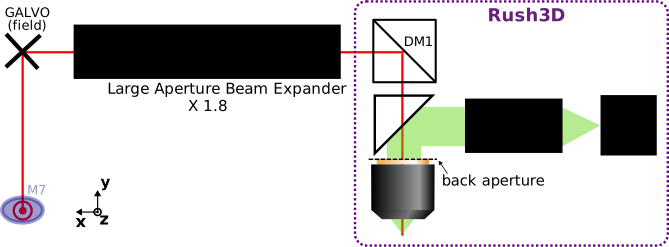
Method: We start by using a blank phase mask (no phase modulation) on the SLM and set the voltages applied to all galvanometers drivers (spiral and field) to 0V. We approximately position the 2D field galvanometer at a height (Y direction) so that it is at one back focal length (375 mm in our case) of the Lens Group LG4. We dont need to be extremely precise here, we use a ruler to achieve +/-3mm precision. The X-Z positionning is done relative to the center of the laser beam deflected by the mirror M7. We then display different blazed gratings on the SLM (same ones as in previous steps) to verify that the height is correct (the different beams are crossing at a position between the 2 field galvanometer mirrors). We can also check after the galvanometer mirrors that,whatever the blazed grating phase masks, there are no cropping, meaning the X-Z positionning is also correct.
Once the positions are fixed, we need to tune the galvo drivers voltages so that the deflected beam is parallel to the optical table (the X-Z plane). If not necessary, it is recommended to also align (through positionning and voltage settings) the galvos so that deflected beam is parallel to the X axis (We use the holes in the optical table as references).
Large Aperture Beam Expander (LABE)
Objective: Achieve a ~28mm diameter beam with little aberrations.
Metrics: Centered in/out with the laser beam + diameter stays the same over several meters + 2D field galvo is one back focal length behind the LABE (60 mm in our case)
Method: Similar to the 1st beam expander. We start by noting the position of the laser beam on a screen at a few meters with no LABE lenses. We do this for several distances. Then we add the LABE and change place it so that the current beam position overlapps with previous positions, and iterate (change screen position and move LABE so it overlaps) until it is the same as without the LABE for all screen positions. At the same time, we need to make sure the LABE is approximately one back focal length (60 mm in our case) away fron the field galvanometer mirrors
Note: This methodology can be improved be reducing the beam diameter size to a few mm after LG4 for example. Then use custom 3D printed pinholes at each end of the LABE lenses for better precision and easier alignment.
Combination with Rush3D imager
Objective: Achieving pseudo-telecentricity of the stimulation subsystem and assure minimal distorsions/aberrations
Metrics: Visual inspection for centering + calibration results (step 4) to verify symetry
Method:
Note: Dichroic mirror DM1 is associated with the Rush3D system in this document but it is not a part of the generic Rush3D system. It is an add-on that allows combining the stimulation path with the imaging (Rush3D path). It is however currently physically part of the Rush3D optomechanical system.